Why do GFT go electrofishing.
28th Sep 2025
by Jamie Ribbens
Electrofishing is an effective and safe technique used to catch juvenile fish in freshwater habitats.
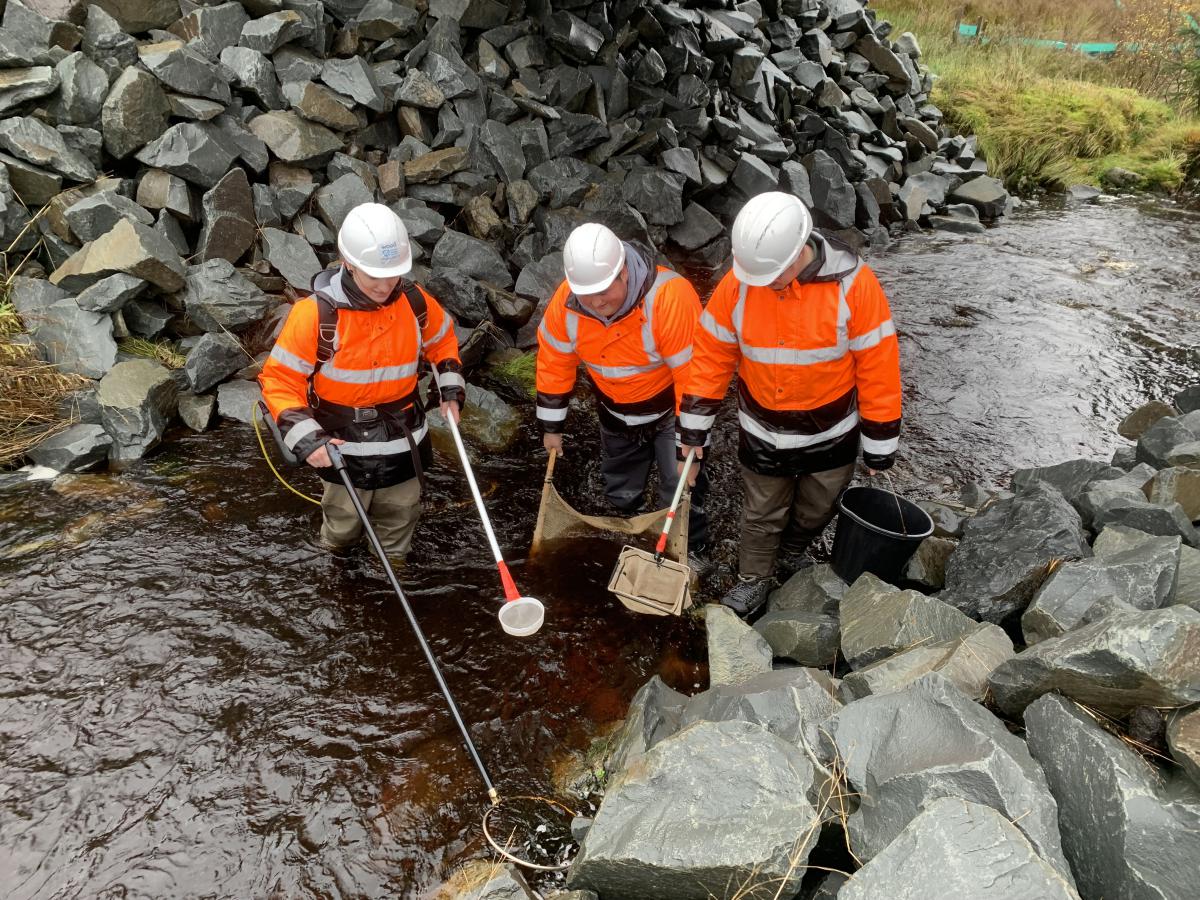
Electrofishing is an effective and safe technique used to catch juvenile fish in freshwater habitats. It involves passing a controlled electric current through the water which temporarily immobilises the fish and causes them to swim toward the anode, the source of the current, where they can be carefully caught in hand nets and put in a bucket. When undertaken properly by trained operators it is entirely safe for fish. All GFT staff that are involved in electrofishing undertake training through the Scottish Fisheries Coordination Centre to secure qualifications in 'Introduction to Electrofishing' and once suitably experienced they complete further training to gain the 'Team Leader' qualification so they can lead electrofishing surveys. Regular refresher courses, every 5 years, are required for Team Leaders. Many of these courses are run in Galloway by GFT Biologist Rowan who is an experienced and qualified trainer.
Electrofishing is an important tool for fisheries management. This survey technique is particularly suited for the monitoring of juvenile salmon and trout between July and September in shallow riffle and run areas. Electrofishing techniques can be modified for sampling other species such as juvenile lamprey, which live buried in sediment and require the anode to 'hover' for longer over their habitats. European eels are difficult to draw out of some rocky habitats and require multiple electrofishing runs to catch sufficient numbers of the overall population.
GFT undertake up to three hundred electrofishing surveys each summer for a wide range of purposes. On the Luce, Water of Fleet, Tarf Water and Urr we undertake timed fry surveys to help understand annual fluctuations in wild salmon spawning and distribution. Electrofishing is also used to monitor the spread of various invasive non-native signal crayfish populations in Galloway.
Electrofishing also has a role in hatchery operations both to collect adult salmon broodstock and to monitor survival rates of stocked salmon. This summer GFT monitored stocked salmon survival and growth rates from both the Bladnoch and Cree hatchery programmes.
Construction works can impact on fish populations through physical damage, poor water quality or habitat damage. In some cases it is best to remove fish from the immediate work site prior to the work starting, electrofishing can be used to perform a fish rescue. Larger construction projects, such as renewable energy schemes, could cause significant impacts over large areas. It is common practice for detailed monitoring programmes to be required, often as a planning condition, which allows suitable mitigation to be put into place if impacts are identified. GFT are involved in delivering Fish Monitoring Plans for various construction projects in Dumfries and Galloway.
Our 'Flowing Forward - Restoring Galloways Rivers' work programme uses electrofishing data to help identify areas where fish populations are depleted due to poor habitats or water quality. Electrofishing also plays an important role in monitoring how effective our habitat restoration works have been to recover key indicator fish species.
Latest News
Investigating the prevalence of fungal infected Atlantic salmon at Tongland fish pass.
During the summer this year, we undertook a project (commissioned by Scottish Power) examining why in some years at Tongland fish pass there are a larger number of returning adult Atlantic salmon which are heavily infected with Saprolegnia fungus, in comparison to other years.
Urr timed electrofishing results
A summary of the 2018 timed electrofishing surveys for the Urr are provided. These surveys target salmon fry and provide information on annual fluctuations and distribution across 12 sites spread over the catchment.
The new Saving the Sparling intern starts
We would like to introduce the new Saving the Sparling intern who started on Monday the 17th December. Courtney Rowland will be working for the next 5 months on delivering phase 2 of the Saving the Sparling Project.